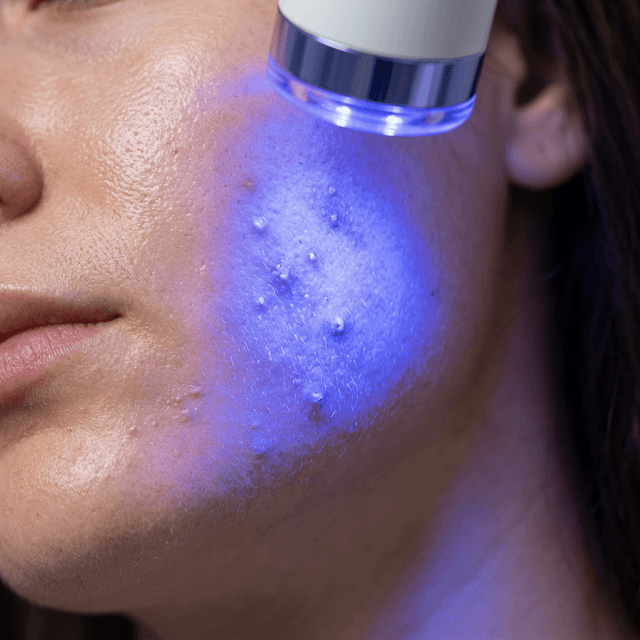
If you've tried topical treatments, antibiotics, and dietary changes without clearing your acne, light therapy might be the piece you're missing. But not just any light — the science points to specific wavelengths that target the biological causes of acne.
This guide covers the clinical evidence for using LED face masks to treat acne, the wavelengths that matter, optimal protocols, and what realistic improvement looks like over time.
How Light Targets Acne: The Biological Mechanism
Acne is primarily caused by Cutibacterium acnes (formerly Propionibacterium acnes), a bacterium that colonizes hair follicles and triggers inflammatory responses. These bacteria have a unique vulnerability: they naturally produce porphyrins — light-sensitive molecules that absorb specific wavelengths of visible light.
Blue Light (405–420 nm): The Bacterial Killer
When blue light at approximately 415 nm hits porphyrins inside C. acnes, it triggers a photochemical reaction that produces reactive oxygen species (ROS). These ROS destroy the bacteria from within — no antibiotics required.
This mechanism is well-documented:
- Papageorgiou et al. (2000) conducted a randomized study with 107 patients. Combined blue-red light treatment achieved 76% improvement in inflammatory lesions after 12 weeks — outperforming benzoyl peroxide 5%, blue light alone, and white light placebo (PubMed).
- Research by Liebmann et al. demonstrated that 415 nm blue light significantly inhibits sebocyte proliferation, suggesting it may also reduce excess oil production — a contributing factor to acne (PubMed).
- Kawada et al. (2002) found that twice-weekly blue light treatments reduced inflammatory acne lesions by 64% after 4 weeks.
A critical advantage of blue light over antibiotics: because it works through a photochemical mechanism rather than a pharmacological one, it doesn't contribute to antibiotic resistance — an increasingly important concern in dermatology.
Red Light (630–660 nm): The Anti-Inflammatory Partner
Red light doesn't kill bacteria directly, but it plays a crucial supporting role in acne treatment:
- Reduces inflammation: Red light downregulates pro-inflammatory cytokines, helping calm the redness and swelling around active breakouts
- Promotes healing: By stimulating cellular repair, red light accelerates the resolution of existing lesions and reduces post-inflammatory marks
- Prevents scarring: The collagen-stimulating effect of red light helps repair dermal damage caused by severe acne, reducing the risk of permanent scarring
This is why the combined blue + red approach consistently outperforms either wavelength alone in clinical trials. Blue light eliminates the cause (bacteria), while red light addresses the consequences (inflammation and scarring).
Near-Infrared (830 nm): Deep Anti-Inflammatory Support
NIR penetrates deeper than red light, reaching below the dermis. For severe cystic or nodular acne — where inflammation extends deeper — NIR may provide additional anti-inflammatory benefits. However, most clinical acne studies have focused on blue and red wavelengths, so NIR's role in acne treatment is supplementary rather than primary.
LED Masks vs. Other Acne Treatments: Where They Fit
| Treatment | Mechanism | Antibiotic Resistance Risk | Side Effects | Consistency Required |
|---|---|---|---|---|
| Blue light LED | Photochemical bacterial destruction | None | Minimal (mild warmth) | High (4–5x/week) |
| Benzoyl peroxide | Oxidizing agent kills bacteria | Low | Dryness, peeling, bleaching | Daily |
| Topical antibiotics | Inhibits bacterial protein synthesis | High | Irritation, resistance | Daily |
| Oral antibiotics | Systemic bacterial suppression | High | GI issues, resistance, sun sensitivity | Daily for months |
| Retinoids | Increases cell turnover | None | Dryness, irritation, sun sensitivity | Daily |
| Isotretinoin (Accutane) | Shrinks sebaceous glands permanently | None | Significant (requires monitoring) | Daily for 4–6 months |
Key takeaway: LED therapy is not a replacement for severe acne treatments like isotretinoin, but it's an excellent complementary therapy or first-line approach for mild to moderate inflammatory acne — especially for people concerned about antibiotic resistance or topical irritation.
The Optimal Protocol for Acne Treatment
Based on published clinical trials, here's the evidence-based protocol for using LED masks to treat acne:
Phase 1: Active Treatment (Weeks 1–12)
- Wavelength priority: Blue (405–420 nm) + red (630–660 nm)
- Session length: 10–15 minutes
- Frequency: 5 sessions per week (can do daily)
- Skin prep: Clean, dry skin — no products between skin and mask
- Post-session: Apply non-comedogenic moisturizer; avoid heavy occlusives immediately
Phase 2: Maintenance (Week 12+)
- Frequency: Reduce to 2–3 sessions per week
- Purpose: Prevent bacterial recolonization and manage oil production
- Duration: Ongoing — acne-prone skin benefits from long-term bacterial management
Combining LED with Topical Treatments
LED therapy integrates well with most acne treatments:
- With benzoyl peroxide: Use BP in the morning, LED in the evening (or vice versa). Don't apply BP directly before LED — it can interfere with light transmittance.
- With retinoids: Apply retinol or tretinoin after LED sessions, not before. Retinoids temporarily increase skin photosensitivity.
- With niacinamide: Excellent combination — niacinamide regulates sebum and calms inflammation. Can be applied immediately after LED.
- With salicylic acid: Compatible when used at different times of day. Both target different aspects of acne pathology.
For a complete integration protocol, see our step-by-step LED usage guide.
Realistic Results Timeline for Acne
| Timeframe | Expected Changes | What's Happening |
|---|---|---|
| Week 1–2 | Fewer new breakouts forming | C. acnes colony counts declining; porphyrin-mediated destruction beginning |
| Week 3–4 | Noticeably clearer skin; reduced redness | Bacterial load significantly reduced; inflammatory response diminishing |
| Week 6–8 | Major improvement in breakout frequency | Consistent bacterial suppression; post-inflammatory marks starting to fade |
| Week 10–12 | Substantial clearance; skin tone evening out | Long-term bacterial management established; dermal remodeling reducing scarring |
Track your progress with our method described in the before and after timeline guide.
Choosing the Right LED Mask for Acne
Not all LED masks are equally suited for acne treatment. Here's what to prioritize:
Must-Have Features
- Blue wavelength at 405–420 nm: This is non-negotiable. Masks that list "blue" without specifying the nanometer range may use wavelengths outside the porphyrin activation window.
- Combined blue + red capability: The clinical evidence strongly favors the combination approach for superior results.
- Adequate chin and jawline coverage: Hormonal acne concentrates along the lower face — make sure the mask covers these areas adequately.
Nice-to-Have Features
- Near-infrared for deeper anti-inflammatory support
- Flexible material for better LED-to-skin contact
- Individual zone control (treat acne zones with blue while using red elsewhere)
You can filter by acne-relevant features in our Acne & Breakout Support guide or browse the full catalog with specification filters.
Frequently Asked Questions
Can LED masks treat cystic acne?
LED masks are most effective for mild to moderate inflammatory acne (papules, pustules). Cystic and nodular acne involves deeper inflammation that blue light has limited ability to reach. LED therapy can be used as a complement to professional treatment for cystic acne, but it shouldn't be your sole strategy. Consult a dermatologist if you have persistent cystic lesions.
Which is better for acne: blue light or red light?
Blue light is the primary acne-fighting wavelength because it directly kills C. acnes. Red light helps by reducing inflammation and promoting healing. The research clearly shows the combination performs best: Papageorgiou et al. found 76% improvement with blue+red vs. 58% with blue alone. For a deeper comparison, see our wavelength comparison guide.
Will LED therapy make my acne worse initially?
Rarely. Unlike retinoids or chemical exfoliants, LED therapy doesn't cause a "purging" phase. You should not experience increased breakouts from light therapy. If you notice worsening, discontinue use and consult a dermatologist — it may indicate an unrelated sensitivity. See our safety guide for complete information.
Can I use LED alongside prescription acne medication?
In most cases, yes. LED therapy is compatible with most acne medications. The exception: if you're taking photosensitizing medications (doxycycline, some retinoids), consult your prescribing physician before adding light therapy. The wavelengths used in LED masks (visible light, not UV) are generally safe, but photosensitivity can extend across the light spectrum.
How long do I need to keep using the mask?
Acne is a chronic condition for most people — C. acnes bacteria will recolonize follicles over time. Plan for a 12-week active treatment phase followed by indefinite maintenance at 2–3 sessions per week. Read our frequency guide for detailed scheduling advice.
Start Your Acne Protocol
Ready to begin? Our resources will help you choose the right device and build an effective routine:
- Acne & Breakout Support Guide — curated masks with blue light specs
- Compare LED Masks — evaluate devices side by side
- Take the Quiz — personalized recommendation in 60 seconds
Last updated March 20, 2026. All clinical references link to published, peer-reviewed studies. For our full review methodology, visit our methodology page.
From article to shortlist
Open the catalog with concern filters, compare models side by side, or read a focused buying guide.
Find Your Perfect LED Face Mask
Browse our curated collection of verified LED face masks. Compare wavelengths, materials, and specs to find the right mask for your skin goals.
Browse Collection →