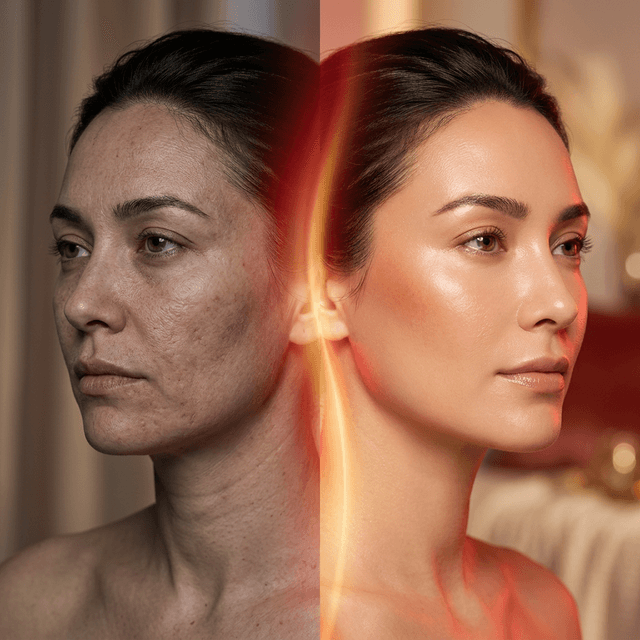
"How long until I see results?" It's the most common question about red light therapy, and the most commonly oversimplified answer is "4–6 weeks." The reality is more nuanced — and more interesting.
The timeline for visible results depends on three variables: what you're treating (fine lines vs. acne vs. skin tone), your device's specifications (wavelength, irradiance, LED count), and how consistently you use it (sessions per week). In this article, we break down the clinical evidence for each phase of improvement so you can track realistic progress.
Understanding the Biology Behind the Timeline
Before diving into week-by-week expectations, it helps to understand why results take weeks — not days — to appear.
The Collagen Remodeling Cycle
Collagen is the structural protein responsible for skin firmness and elasticity. When red light (630–660 nm) stimulates fibroblasts in the dermis, those cells begin producing new collagen fibers. But collagen maturation is slow:
- Days 1–7: Fibroblasts upregulate procollagen synthesis (the collagen precursor). This is happening at a cellular level — invisible to the naked eye.
- Weeks 2–4: Procollagen molecules are processed and begin cross-linking into mature collagen fibers. The dermis is starting to restructure, but surface-level changes are still minimal.
- Weeks 4–8: Enough new collagen has accumulated to produce measurable changes in skin thickness and elasticity. Fine lines begin to visibly soften.
- Weeks 8–12: Structural remodeling reaches a clinically significant level. The Ablon (2018) study showed that most improvements became statistically significant at this stage (PubMed).
- Weeks 12–16+: Peak cumulative results. Beyond this point, maintenance sessions preserve gains but the rate of improvement plateaus.
This timeline is a biological constraint, not a device limitation. No LED mask — regardless of price — can accelerate the fundamental biology of collagen maturation.
The Acne Clearance Cycle
Blue light (405–420 nm) works faster than red light for its primary application because bacterial elimination is a more rapid process than collagen synthesis:
- Days 1–14: Blue light activates porphyrins within C. acnes bacteria, generating reactive oxygen species that destroy the bacteria. Colony counts begin declining.
- Weeks 2–4: Reduction in new inflammatory breakouts becomes noticeable. Existing lesions continue healing through the normal inflammatory cycle.
- Weeks 4–8: Significant reduction in active acne. Papageorgiou et al. (2000) reported up to 76% improvement in inflammatory lesions at 12 weeks with combined blue-red treatment (PubMed).
Week-by-Week Progress: What Clinical Studies Show
The following timeline is compiled from published clinical trial data, not anecdotal reports. We focus on the three most common treatment goals: anti-aging, acne, and general skin health.
Weeks 1–2: The Foundation Phase
| Concern | What's Happening | What You May Notice |
|---|---|---|
| Anti-aging | Fibroblast activation, increased ATP production, early procollagen synthesis | Subtle "glow" from improved surface blood flow. Skin may feel slightly plumper after sessions. |
| Acne | C. acnes colony reduction beginning, reduced inflammatory signaling | Fewer new breakouts forming. Existing pimples still healing normally. |
| Skin tone | Mild vasodilation improves surface microcirculation | Temporary healthy flush post-session. Slight improvement in skin radiance. |
Key insight: The improvements in week 1–2 are mostly functional (cellular metabolism) rather than structural (visible tissue changes). Don't judge your mask's effectiveness at this stage.
Weeks 3–4: Early Visible Changes
| Concern | What's Happening | What You May Notice |
|---|---|---|
| Anti-aging | Procollagen cross-linking into mature collagen. Early elastin fiber restoration. | Fine lines appear slightly softer, especially around eyes. Skin texture feels smoother. |
| Acne | Significant C. acnes reduction. Anti-inflammatory effects reducing existing lesion severity. | Noticeably fewer new breakouts. Post-inflammatory redness starting to fade. |
| Skin tone | Reduced oxidative stress. Mild improvement in melanin distribution. | More even complexion. Dark spots may begin lightening slightly. |
This is the stage where most people start to notice something is different. The changes are subtle but real — often described as "my skin just looks healthier" rather than dramatic transformation.
Weeks 6–8: Measurable Progress
| Concern | What's Happening | What You May Notice |
|---|---|---|
| Anti-aging | Collagen density increasing measurably (confirmed by ultrasound in clinical studies). Dermal thickness improving. | Visible reduction in fine lines. Skin firmness improvement noticeable to the touch. |
| Acne | Consistent bacterial suppression. Sebum regulation (if using blue light). New breakout frequency significantly reduced. | Skin is noticeably clearer. Post-acne marks beginning to fade. |
| Skin tone | Cumulative anti-oxidant effects. Improved cellular turnover. | More uniform skin tone. Texture improvements visible in ambient lighting. |
The Lee et al. (2007) study documented histological changes (increased collagen and elastic fibers) through biopsy at this stage, confirming that the visible improvements correspond to real structural changes in the dermis (PubMed).
Weeks 10–12: Peak Results Phase
| Concern | What's Happening | What You May Notice |
|---|---|---|
| Anti-aging | Collagen remodeling mature. Elastin restoration significant. Dermal matrix substantially strengthened. | Noticeable firmness improvement. Most fine lines visibly reduced. Skin looks younger and more resilient. |
| Acne | Bacterial population consistently suppressed. Inflammation cycle disrupted long-term. | Major improvement in breakout frequency and severity. Post-inflammatory marks significantly faded. |
| Skin tone | Melanin distribution normalized. Surface texture refined. | Visibly more even, brighter complexion. Pores appear refined. |
The Ablon (2018) study confirmed that 87% of participants showed improved skin tone and firmness by week 12, with statistically significant improvements in roughness, hydration, and collagen density (PubMed).
Week 16 and Beyond: Maintenance
After 12–16 weeks, the rate of improvement typically plateaus. The collagen your skin has produced is there — but it won't continue accumulating at the same rate. At this point, you transition from a "building" protocol to a "maintenance" protocol:
- Building phase: 4–5 sessions per week, 10–15 minutes each
- Maintenance phase: 2–3 sessions per week, 10 minutes each
If you stop using LED therapy entirely, the improvements don't disappear overnight. Collagen has a natural turnover rate of 1–2 years. However, without continued stimulation, the rate of new collagen production returns to baseline, and visible results gradually diminish over several months.
Factors That Affect Your Personal Timeline
Not everyone will follow the exact timeline above. Several factors can accelerate or slow your results:
Factors That May Speed Up Results
- Higher-specification device: Masks with precise wavelengths (633 nm, 830 nm), higher irradiance, and higher LED count deliver more therapeutic energy per session
- Consistent daily use: The clinical studies showing the best results used minimum 4–5 sessions per week with no gaps
- Complementary skincare: Using vitamin C (morning) and retinol (evening) alongside LED therapy can synergize — vitamin C is a collagen co-factor, and retinol independently stimulates cell turnover
- Adequate hydration and nutrition: Collagen synthesis requires vitamin C, zinc, and adequate protein — supplementation may help if dietary intake is low
Factors That May Slow Results
- Inconsistent use: Missing sessions disrupts the cumulative dose effect. Even 2 days off per week significantly reduces total fluence
- Age and baseline skin condition: Younger skin with less accumulated damage may show improvements faster, but skin with more damage has more room for measurable improvement
- Low-power device: Masks with unreported irradiance or very few LEDs may deliver sub-therapeutic doses, extending the timeline or reducing overall effectiveness
- Smoking or high UV exposure: Both accelerate collagen breakdown, which can partially counteract the synthesis LED therapy stimulates
- Photosensitizing medications: Some medications alter skin's response to light, potentially affecting treatment efficacy
How to Track Your Progress
We recommend a structured approach to tracking rather than relying on mirror checks:
- Baseline photos: Take photos in consistent lighting (same spot, same time of day) on Day 1. Include front, left profile, and right profile views.
- Monthly comparison photos: Repeat at weeks 4, 8, and 12 under identical conditions. Side-by-side comparison reveals changes that day-to-day observation misses.
- Texture check: Run your fingers across your cheek and forehead before starting and at monthly intervals. Smoother texture is often one of the earliest tactile changes.
- Breakout log: If treating acne, keep a simple tally of new breakouts per week. A declining trend is more meaningful than any single data point.
Frequently Asked Questions
Why don't I see results after 2 weeks?
Two weeks is too early for structural changes. At this stage, collagen precursors are just beginning to form. The first visible improvements typically appear at weeks 3–4, with significant results at weeks 8–12. Review our evidence review for the clinical timelines.
Can I speed up results by using the mask longer each session?
Longer sessions don't necessarily mean faster results. Photobiomodulation follows a biphasic dose response — there's an optimal dose window where benefits peak, and exceeding it can reduce effectiveness. Stick to your device's recommended session length (typically 10–20 minutes). What matters more is frequency (sessions per week) and consistency (weeks of continuous use). See our frequency guide for optimal protocols.
Will my results disappear if I stop using the mask?
Not immediately. Mature collagen has a natural lifespan of 1–2 years. However, without continued LED stimulation, the rate of new production returns to baseline, and improvements will gradually fade over several months. This is why a maintenance protocol (2–3 sessions/week) is recommended after the initial building phase.
Do certain wavelengths show results faster?
Blue light for acne tends to show faster visible results (2–4 weeks) because bacterial elimination is a rapid process. Red and NIR for anti-aging take longer (8–12 weeks) because collagen remodeling is a slower biological process. Neither is "better" — they serve different purposes. Read our complete wavelength comparison.
How do I know if my mask is powerful enough?
Check whether your device discloses irradiance (mW/cm²) and specific wavelengths (nm). Devices that withhold these specs may be underpowered. Compare devices using our LED mask catalog where we surface available specification data for every product.
Start Your Timeline
Every day you wait is a day of cumulative results you could be building. If you haven't started, the best time is now — and the second-best time is tomorrow.
Find a device matched to your goals:
- Anti-Aging & Firmness Guide — for fine lines, collagen, and skin texture
- Acne & Breakout Support Guide — for breakouts and oil control
- Take the Quiz — personalized recommendations in 60 seconds
Last updated March 20, 2026. Timeline data sourced from published clinical trials. For our full methodology, visit our review methodology page.
From article to shortlist
Open the catalog with concern filters, compare models side by side, or read a focused buying guide.
Find Your Perfect LED Face Mask
Browse our curated collection of verified LED face masks. Compare wavelengths, materials, and specs to find the right mask for your skin goals.
Browse Collection →