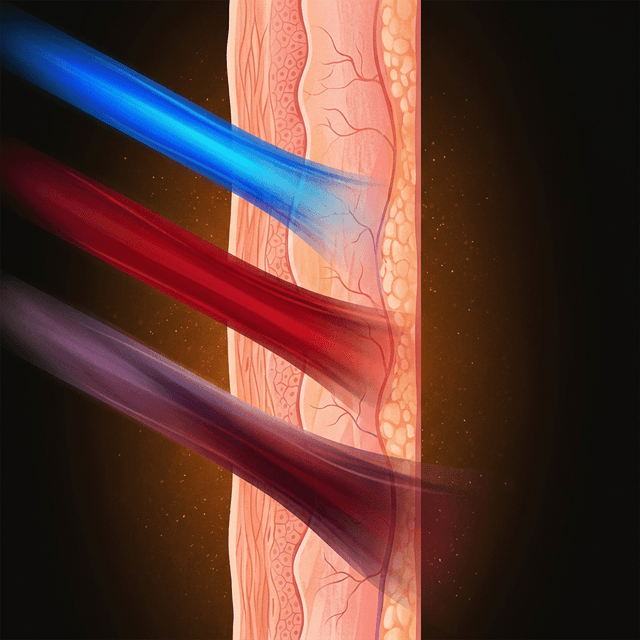
Walk into the LED face mask market and you'll see products advertising every color of the rainbow — red, blue, green, amber, near-infrared, even cyan. But here's the reality: not all wavelengths are backed by the same quality of evidence. Let's break down what each one actually does, starting with the ones that matter most.
The Electromagnetic Spectrum and Your Skin
Visible light ranges from about 380nm (violet) to 700nm (deep red). Beyond 700nm enters the near-infrared range, which is invisible to the human eye but still biologically active. The key insight is that different wavelengths penetrate to different depths in your skin:
- Blue (415nm) — Surface level, reaches the epidermis
- Green (525nm) — Shallow dermis
- Amber/Yellow (590nm) — Mid dermis
- Red (630–660nm) — Upper to mid dermis (1–2mm)
- Near-Infrared (810–850nm) — Deep dermis and beyond (3–5mm)
Deeper penetration doesn't automatically mean "better" — it means the light affects different cellular targets.
Red Light (630–660nm): The Anti-Aging Workhorse
Evidence level: Strong
What it does: Stimulates collagen and elastin production by activating fibroblast cells. Increases microcirculation, which brings more oxygen and nutrients to the skin.
Best for:
- Fine lines and wrinkles
- Skin texture and tone improvement
- Post-inflammatory hyperpigmentation (with consistent use)
- General skin rejuvenation
What the research says: The 660nm wavelength specifically has robust clinical data. A 2014 controlled trial showed significant improvements in skin complexion, collagen density, and skin roughness. Multiple other studies confirm collagen-stimulating effects at this wavelength range.
Typical session: 10–20 minutes, 3–5 times per week
Blue Light (415nm): Acne Treatment
Evidence level: Moderate to Strong
What it does: Targets porphyrins — molecules produced by P. acnes bacteria — causing a photochemical reaction that destroys the bacteria without antibiotics.
Best for:
- Mild to moderate inflammatory acne
- Reducing active breakouts
- Maintaining clear skin when used as prevention
Limitations: Blue light only addresses the bacterial component of acne. It doesn't reduce sebum production, address hormonal factors, or treat clogged pores. For best results, combine with a comprehensive skincare routine.
Typical session: 10–15 minutes, daily during active breakouts, then 2–3 times per week
Near-Infrared (810–850nm): The Deep Healer
Evidence level: Strong
What it does: Penetrates beyond the dermis into deeper tissues. Strongly absorbed by cytochrome c oxidase in mitochondria, boosting ATP production and modulating inflammatory pathways.
Best for:
- Inflammation reduction
- Wound healing and post-procedure recovery
- Supporting deeper collagen networks
- General cellular health and energy
Key detail: You can't see NIR light — if a mask claims to use 850nm, you shouldn't see a bright glow from those specific LEDs. Some red glow may be visible from other LEDs in the same mask, but the NIR wavelength itself is invisible.
Typical session: 15–20 minutes, 3–5 times per week
Amber/Yellow Light (590nm): The Calmer
Evidence level: Limited but Promising
What it does: May help soothe irritated skin and reduce redness. Some evidence suggests it supports lymphatic drainage and can calm reactive skin.
Best for:
- Sensitive or reactive skin types
- Redness reduction
- Post-inflammatory soothing
Honest assessment: The evidence base for 590nm is smaller than for red and NIR. If your primary concern is anti-aging or acne, red and blue wavelengths have more research support. Amber light is a nice addition if your mask includes it, but it shouldn't be the primary reason you buy a device.
Green Light (525nm): The Most Overhyped?
Evidence level: Limited
What it does: Some claims around hyperpigmentation and calming effects, but clinical evidence is much thinner compared to red, blue, and NIR.
Honest assessment: If a 7-color mask includes green, it won't hurt — but we wouldn't recommend buying a device primarily for green light therapy.
Which Combination Should You Choose?
| Your Main Concern | Primary Wavelength | Secondary Wavelength |
|---|---|---|
| Anti-aging / Fine lines | Red (660nm) | NIR (850nm) |
| Acne / Breakouts | Blue (415nm) | Red (660nm) |
| General skin health | Red (660nm) | NIR (850nm) |
| Post-procedure recovery | NIR (850nm) | Red (660nm) |
| Sensitive / Reactive skin | Red (660nm) | Amber (590nm) |
Browse our LED face mask catalog to filter by specific wavelengths and find masks that match your skin goals.
Frequently Asked Questions
Do I need all wavelengths in one mask?
No. A dual-wavelength mask with red (660nm) and near-infrared (850nm) covers the two most evidence-backed applications. Multi-color masks offer versatility, but a focused dual-wavelength device can be equally effective for specific concerns.
Can different wavelengths be used at the same time?
Yes. In fact, many studies showing the best results use simultaneous red + NIR or blue + red delivery. There's no interference between wavelengths — they target different chromophores and tissue depths.
From article to shortlist
Open the catalog with concern filters, compare models side by side, or read a focused buying guide.
Find Your Perfect LED Face Mask
Browse our curated collection of verified LED face masks. Compare wavelengths, materials, and specs to find the right mask for your skin goals.
Browse Collection →