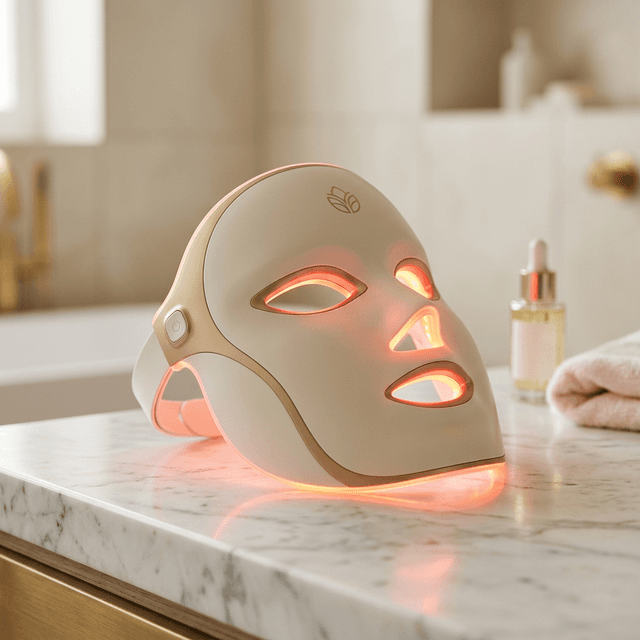
The LED face mask market has exploded — projected to grow from $334 million in 2025 to $820 million by 2033 (SkyQuest, 2025). With that growth comes dozens of devices competing for attention, many with nearly identical marketing language but very different engineering under the hood.
This guide cuts through the noise. Instead of ranking products by brand prestige or influencer endorsements, we focus on the specifications that peer-reviewed research shows actually matter — wavelength precision, irradiance, LED count, material quality, and protocol transparency.
The 5 Specifications That Determine Whether a Mask Works
Before looking at any specific product, you need to understand what makes an LED mask effective. Clinical research has identified five key variables that determine therapeutic outcomes.
1. Wavelength Precision — The Single Most Important Factor
Different wavelengths trigger different biological responses. The clinically validated ranges are:
| Wavelength Range | Color | Penetration Depth | Primary Benefit | Key Studies |
|---|---|---|---|---|
| 630–660 nm | Red | Epidermis + upper dermis (1–3 mm) | Collagen stimulation, wrinkle reduction | Lee et al. 2007; Ablon 2018 |
| 405–420 nm | Blue | Epidermis only (0.5–1 mm) | Acne bacteria elimination (C. acnes) | Papageorgiou et al. 2000 |
| 830–850 nm | Near-infrared | Deep dermis + subdermis (3–5 mm) | Anti-inflammation, tissue repair | Chung et al. 2012 |
| 520–560 nm | Green | Upper epidermis (0.5–1 mm) | Pigmentation (limited evidence) | Emerging research |
| 570–590 nm | Yellow/Amber | Epidermis (0.5–1.5 mm) | Redness calming (limited evidence) | Wunsch & Matuschka 2014 |
Red flag: If a mask advertises "7 colors" without listing specific nanometer values for each wavelength, the additional colors (green, yellow, cyan, purple) are likely marketing additions with minimal clinical backing. The three wavelengths with strong RCT evidence are red (~633 nm), blue (~415 nm), and NIR (~830 nm).
2. Irradiance (Power Density)
Irradiance, measured in milliwatts per square centimeter (mW/cm²), determines how much light energy reaches your skin per unit time. Clinical studies typically use 20–100 mW/cm².
Most consumer masks operate in the 5–30 mW/cm² range. This is lower than clinical devices but still therapeutically relevant when compensated by increased session frequency (daily vs. weekly). The Arndt-Schulz rule in photobiology suggests that there's an optimal dose window — too little light produces no effect, too much may be counterproductive. Consumer-grade irradiance levels generally fall within the effective low end of this window.
Transparency indicator: Manufacturers that disclose irradiance values are generally more confident in their engineering. If this specification is absent from the product listing, that's a significant omission.
3. LED Count and Distribution
LED count affects two things: total energy output and coverage uniformity. A mask with 200+ LEDs distributed across the face will deliver more consistent treatment than one with 50 LEDs clustered in certain areas.
- 100–200 LEDs: Entry level — adequate for targeted areas (forehead, cheeks) but may have coverage gaps
- 200–400 LEDs: Mid-range — good full-face coverage for regular home use
- 400–600+ LEDs: Premium — comprehensive coverage with higher total energy delivery
LED count alone isn't a quality indicator — a well-designed 200-LED mask with proper spacing can outperform a poorly designed 500-LED device. But when wavelength and irradiance are equal, more LEDs generally means better results.
4. Material and Fit: Comfort Drives Compliance
The most technologically advanced mask in the world is useless if it sits in a drawer. Compliance (consistent daily use) is the #1 predictor of results in LED therapy, and comfort directly affects compliance.
- Flexible silicone: Conforms to facial contours, minimizes LED-to-skin gap, generally most comfortable for extended wear
- Rigid polycarbonate/ABS: More durable, may have a wider LED-to-skin gap on certain face shapes, often heavier
- Semi-rigid panels: Split the difference — some structural support with limited flexibility
Weight matters too. A mask heavier than 300g can cause pressure on the nose bridge and become uncomfortable during 15–20 minute sessions.
5. Protocol Guidance and Disclosure Quality
This is an underrated but critical factor. Manufacturers who provide detailed protocol guidance — session length, frequency, ramp-up schedule, expected timeline — demonstrate that they've studied the photobiology behind their product.
Look for:
- Specific session length recommendations (not just "up to 15 minutes")
- Frequency guidance (e.g., 5x/week for 12 weeks, then 3x/week for maintenance)
- Expected timeline for results with honest caveats
- Published or cited clinical testing data
How to Evaluate an LED Face Mask: Our Scoring Framework
At LUMIARA, we evaluate every device in our catalog using a structured framework based on the specifications above. Here's a simplified version you can use when shopping:
| Criterion | Weight | What to Look For | Red Flags |
|---|---|---|---|
| Wavelength disclosure | 30% | Specific nm values listed | Only color names, no nm data |
| Irradiance / Power | 25% | mW/cm² figure published | No power specs at all |
| LED count + distribution | 15% | 100+ LEDs with full-face layout | <50 LEDs or clustered design |
| Material + comfort | 15% | Flexible silicone, lightweight | Heavy rigid plastic, no ventilation |
| Protocol + disclosure | 15% | Detailed usage guide, cited testing | Vague claims, no documentation |
We label products in our catalog as "Spec-Rich" (3+ criteria fully disclosed), "Partial Spec" (1–2 criteria disclosed), or "Needs Verification" (minimal disclosure). You can browse and filter by these labels in our catalog.
Categories Worth Considering
Rather than declaring one "best" mask for everyone — which is misleading — here's how to match device categories to your primary skin goal:
Best for Anti-Aging and Collagen Support
What to prioritize: Red light at 630–660 nm combined with near-infrared at 830–850 nm. The Lee et al. (2007) study found the combination of 633 nm + 830 nm produced the best wrinkle reduction results (PubMed).
LED count: 200+ for adequate coverage across wrinkle-prone areas
Protocol: 10–15 minutes, 4–5x per week for minimum 12 weeks
Browse anti-aging options in our Anti-Aging & Firmness guide.
Best for Acne and Breakout Control
What to prioritize: Blue light at 405–420 nm for bacterial elimination, ideally combined with red light for anti-inflammatory support. The Papageorgiou et al. (2000) study found that combined blue-red treatment outperformed benzoyl peroxide for inflammatory acne (PubMed).
LED count: Higher count in the cheek and jawline areas where breakouts are most common
Protocol: 10 minutes, 5x per week for 8–12 weeks
See acne-focused options in our Acne & Breakout Support guide.
Best for Full Coverage (Face + Neck)
What to prioritize: Masks that extend below the jawline to cover the neck and décolletage. These areas show aging signs early but are often neglected. Look for flexible designs that maintain LED-to-skin contact across the broader surface area.
Compare face + neck options in our Face + Neck Coverage guide.
Common Mistakes Buyers Make
After reviewing hundreds of LED masks, here are the most common mistakes we see consumers make:
1. Choosing by Color Count
"7 colors" or "8 colors" sounds impressive, but only 3 wavelengths (red, blue, NIR) have strong clinical evidence. Additional colors like green, yellow, and cyan have emerging but limited research backing. Don't pay a premium for colors that are essentially experimental. Learn more in our wavelength comparison article.
2. Ignoring Irradiance
A mask with 300 LEDs at very low irradiance may deliver less total energy than a mask with 150 high-power LEDs. LED count alone doesn't tell the full story. If the manufacturer doesn't publish irradiance data, consider that a transparency gap.
3. Expecting Overnight Results
Collagen remodeling is a biological process that takes weeks. Clinical studies consistently show 8–12 weeks for measurable anti-aging results and 4–8 weeks for acne improvements. Any brand promising visible changes in days is misrepresenting the science. See our realistic results timeline.
4. Not Comparing Power-to-Price Ratio
The most expensive mask isn't always the most effective. Compare on specifications, not price point. A $200 mask with disclosed wavelengths, 200+ LEDs, and published irradiance data may outperform a $500 mask that offers only "7 color modes" with no technical specifications.
5. Stopping Too Soon
Many users quit after 3–4 weeks when they don't see dramatic changes. The Ablon (2018) study showed that most improvements became statistically significant at week 12. Consistency through the plateau period is essential.
How We Review LED Masks at LUMIARA
Our review methodology is based on disclosure quality rather than subjective ratings. We don't assign star ratings or declare winners — instead, we surface the specifications that matter and label them for transparency:
- Spec-Rich: Wavelengths, LED count, and material all disclosed with clear values
- Partial Spec: At least one key specification is disclosed, but gaps remain
- Needs Verification: Marketing claims present, but core specifications are missing or vague
This approach lets you make informed decisions based on data rather than brand reputation. You can use our side-by-side comparison tool to evaluate devices directly against each other.
Frequently Asked Questions
How much should I spend on a red light therapy mask?
Effective LED masks range from $100 to $500+. The critical factor isn't price but specification disclosure. A mid-range device ($150–$300) with transparent wavelength, LED count, and irradiance data will likely outperform an expensive device with vague specifications. Focus on the engineering, not the brand name.
Do more expensive masks work significantly better?
Not necessarily. Higher price often reflects brand positioning, packaging, and marketing rather than superior LED technology. The LEDs used in most consumer masks come from a small number of semiconductor manufacturers, and the therapeutic wavelengths are well-established. What you're really paying for is build quality, comfort, and (importantly) testing/certification.
How long does an LED face mask last?
Quality LED masks have a rated lifespan of 10,000–50,000 hours of LED operation. At 15 minutes per session, 5 days a week, that's roughly 10–40 years of use before LED degradation becomes significant. The housing, straps, and controller may require replacement before the LEDs do.
Can I use a red light mask with retinol?
Yes, but with a caveat. Apply retinol after your LED session, not before. Retinol can temporarily increase photosensitivity, and while LED light is not UV, using retinol before a session may cause mild irritation in sensitive individuals. For a complete skincare integration guide, see our step-by-step usage guide.
Should I choose a mask with or without near-infrared?
If your primary concern is anti-aging or skin firmness, NIR (830–850 nm) adds meaningful value. Research by Lee et al. (2007) showed that combining 633 nm red + 830 nm NIR produced better wrinkle reduction than either wavelength alone. If you're primarily targeting acne, NIR is less critical — blue light is the key wavelength. For a breakdown, read our complete wavelength guide.
Start Comparing
Skip the marketing. Browse our LED mask catalog to filter by wavelength, LED count, form factor, and verification label. Or take our personalized recommendation quiz to find matches for your specific skin goals.
For targeted recommendations, explore our buyer guides:
- Best LED Masks for Anti-Aging & Firmness
- Best LED Masks for Acne & Breakout Support
- Best LED Masks with Face + Neck Coverage
Last updated March 20, 2026. All clinical references link to peer-reviewed studies. For our full review methodology, visit our methodology page.
From article to shortlist
Open the catalog with concern filters, compare models side by side, or read a focused buying guide.
Find Your Perfect LED Face Mask
Browse our curated collection of verified LED face masks. Compare wavelengths, materials, and specs to find the right mask for your skin goals.
Browse Collection →